
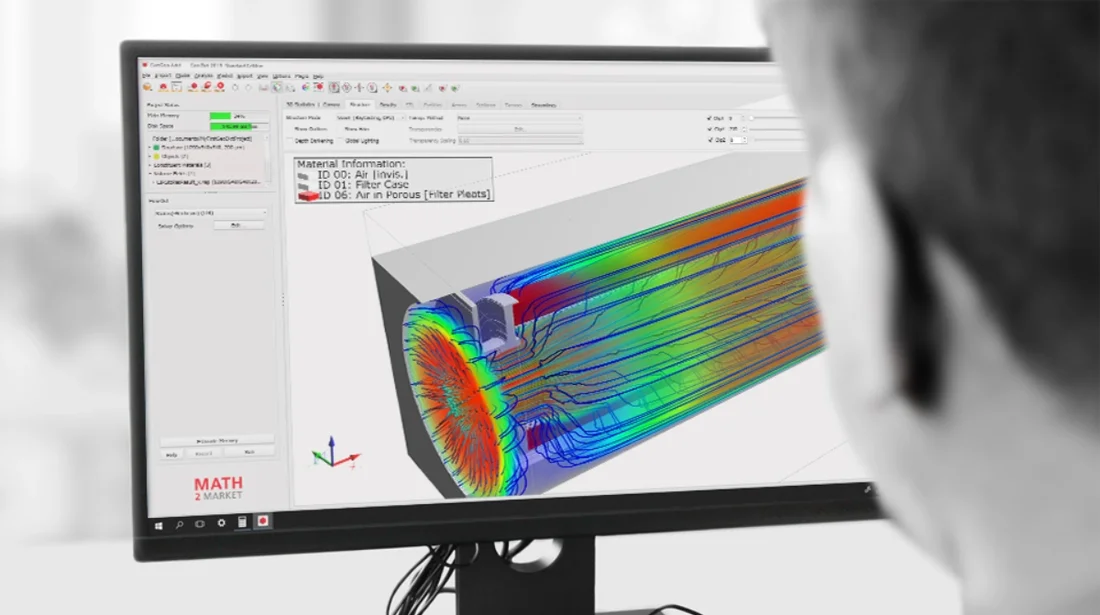
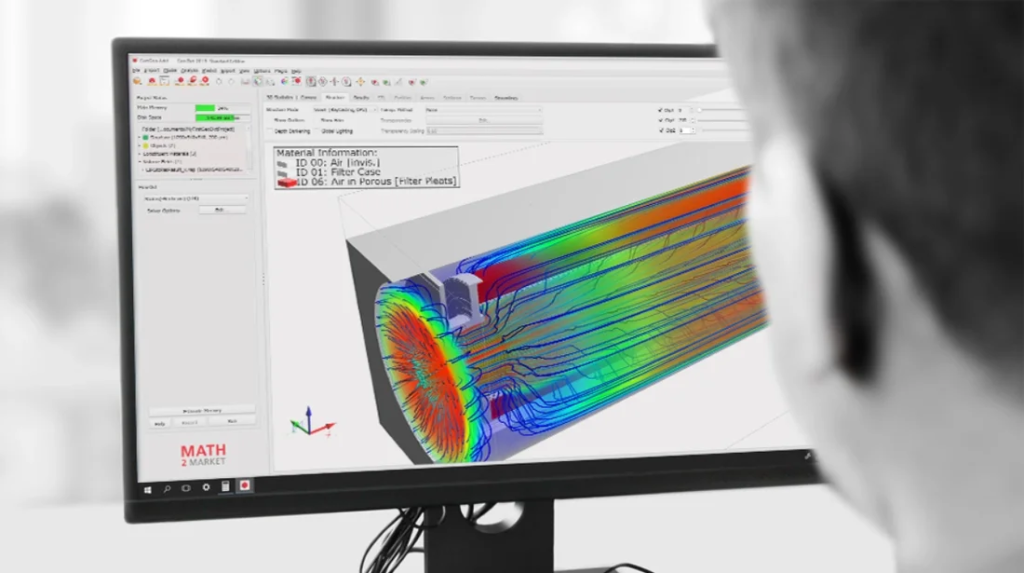
Computational fluid dynamics (CFD) is a powerful engineering method used to mathematically model and solve fluid flow, heat transfer, momentum, mass transport, and energy transfer problems. Modern CFD software enables engineers, scientists, and researchers to simulate complex physical phenomena directly on a computer, eliminating much of the time, cost, and effort associated with traditional testing methods.
Thanks to advances in computing power, CFD software has become an essential tool across industries, helping professionals analyze, test, and optimize designs while ensuring compliance with physical laws. From aerospace and automotive engineering to pharmaceuticals and energy production, CFD software plays a critical role in solving challenging engineering problems.
Here’s why computational fluid dynamics software has become increasingly popular.
Why CFD Software?
Engineers, scientists, and researchers use CFD software to predict and simulate fluid flow, heat transfer, species transport, chemical reactions, particle movement, rigid-body dynamics, and other complex physical processes that would otherwise be difficult, expensive, or time-consuming to investigate experimentally.
For example, in the pharmaceutical industry, biomanufacturing processes used to produce biologic medicines require highly controlled environments. These products are often created within stirred tank bioreactors that rely on a continuous oxygen supply for optimal performance.
Oxygen transfer within these systems is governed by complex fluid dynamics. As manufacturers move from laboratory-scale bioreactors to large-scale production systems holding thousands of liters, maintaining consistent oxygen distribution becomes increasingly challenging.
CFD software helps address these challenges by providing a physics-based approach to modeling oxygen transfer and fluid behavior. By accurately predicting fluid flow patterns across multiple vessel sizes, manufacturers can optimize scale-up processes, improve efficiency, and reduce development risks.
The benefits of CFD software can be summarized in three key advantages:
- Save time
- Save money
- Solve more complex physics problems
To better understand why CFD software is so effective, it is helpful to explore its evolution and the technologies that power modern simulation tools.
History of Computational Fluid Dynamics Software
The study of fluid dynamics has fascinated scientists and engineers for centuries. Efforts to mathematically describe fluid motion can be traced back to the seventeenth century when foundational physical laws were first developed to explain the behavior of moving fluids.
The modern era of computational fluid dynamics began in the early twentieth century as numerical methods and mathematical modeling techniques advanced. By the mid-twentieth century, researchers were able to generate numerical solutions through extensive calculations, which eventually transitioned to computer-based computations as early computing systems became available.
Commercial CFD software emerged during the 1980s as publicly available computational codes became more accessible to engineers and researchers. Since then, continuous improvements in algorithms, hardware, and computing capabilities have transformed CFD into one of the most valuable engineering analysis tools available.
Today, CFD software can run on laptops, workstations, high-performance GPU clusters, and cloud-based platforms, making advanced simulations more accessible than ever before.
How CFD Software Works: 3 Essential Features
Not all CFD software solutions deliver the same level of performance. To solve increasingly complex engineering challenges efficiently and accurately, modern CFD software should include three essential features.
1. Modern Algorithms
Advanced CFD software relies on sophisticated numerical algorithms capable of solving time-dependent fluid flow equations with high accuracy.
Unlike traditional simulation methods that focus primarily on steady-state flow behavior and simplified turbulence models, modern approaches provide detailed representations of fluid dynamics over time. These methods enable engineers to capture complex flow structures, turbulence effects, and transient phenomena more accurately.
As a result, users benefit from improved simulation fidelity, faster processing times, and better scalability when modeling increasingly complex systems.
2. Modern GPU Architectures
Powerful algorithms require equally powerful hardware. Modern graphics processing units (GPUs) provide substantial computational performance compared to traditional processing methods, allowing simulations to run significantly faster.
High-resolution computational grids improve simulation accuracy and enable engineers to capture more detailed physical behavior. However, increased model complexity also requires greater computational resources.
GPU-accelerated CFD software enables users to simulate transient, three-dimensional fluid behavior in near real-time, making advanced analyses more practical and accessible.
Many CFD applications still rely heavily on traditional central processing units (CPUs). For faster simulations and improved performance, engineers should consider CFD software specifically optimized for GPU-based computing architectures.
3. Minimal User Setup
The effectiveness of CFD software depends not only on computational performance but also on ease of use. Engineers need solutions that simplify model preparation, simulation setup, and result visualization.
Modern CFD software should enable users to begin analyzing designs quickly without spending excessive time preparing geometry or configuring complex workflows.
Import Low-Quality or Imperfect Geometry Files
A user-friendly CFD platform should handle imperfect geometry files efficiently, reducing the need for extensive computer-aided design (CAD) repairs and geometry cleanup.
This capability allows engineers to focus on solving engineering challenges rather than spending valuable time correcting design files before simulation.
Use Existing and Custom Fluid Models
Advanced CFD software should provide a foundation of validated fluid models that users can easily customize for specific applications.
By combining robust fluid solvers with high-resolution computational meshes, engineers can incorporate additional physical phenomena and specialized models to address a wider range of engineering problems more efficiently.
Analyze Data in Real Time
Real-time data analysis significantly accelerates engineering workflows. Modern CFD software with integrated post-processing capabilities enables users to visualize, monitor, and evaluate simulation results as they are generated.
This immediate access to data helps engineers make faster decisions, identify design issues earlier, and shorten development cycles.
Conclusion
Computational fluid dynamics software has evolved dramatically over the past several decades. Advances in numerical algorithms, GPU computing, and user-friendly workflows have transformed CFD into an indispensable engineering tool.
Modern CFD software enables engineers, scientists, and researchers across industries to simulate complex fluid behavior, optimize designs, reduce development costs, and solve challenging physics problems faster than ever before. By combining advanced computational methods with high-performance hardware, today’s CFD solutions deliver levels of speed and accuracy that increasingly rival traditional experimental testing methods.

